many kinds of distance

“Distant Reading” by Peter Middleton is (so far anyway) the most brilliant, intriguing and irritating book on poetry I’ve read.  Yes, all of the above.  And it’s not even that some essays in this book are brilliant, some intriguing, some irritating.  They are almost always all three simultaneously.

While it is a collection of eight discontinuous essays, they are linked by a desire to talk about poetry beyond the “meaning inherent in the text”, which Middleton rightly questions.  He sees a poem not just as a literary product but as an historical, cultural, political artefact, circulating via various means, and being transformed by those means.  This includes the poetry reading – in an astounding essay called “A History of the Poetry Reading”, Middleton discusses how intersubjectivity is integral to poetry.

Performance is a moment when social interaction can study and celebrate itself, and the poet is given significant new materials with which to extend the signifying field of the poem…  The presentation of the poetry in a public space to an audience that is constituted by that performance for the time of the reading enables the poem to constitute a virtual public space that is, if not utopian, certainly proleptic of possible social change as part of its production of meaning. (p.103)

No, I didn’t choose the most snappy, accessible quote, did I?  Actually, Middleton does have a keen literary wit, but he’s nothing if not ambitious in his scope.  Interestingly, though, for all of his depth of analysis and his assiduous care in respecting the complexities of how poetry circulates, there is very little mention of the specific and varied embodiments of authors and readers, of what these might mean for poetry.

I’m thinking of how writers and performers like Antony Riddell, Kath Duncan, and Angie Jones claim a space on stage that is entirely their own, that unashamedly present their own embodied difference as valuable and inextricable from literary meaning.  Simply by being themselves, visible and engaging, they expose the anaesthetics of the usual “author-audience” relationship.   The easy empathy, identification or abstraction that is usually generated by poetry readings is made all the more complicated and (appropriately) fraught.  I include myself in this.  When I got up in a Brunswick pub and read for the first time, “I have a hunch / that curvature / can be aperture…”, I knew that this was my poem, not just as author, but as this body on this stage.  That sharp intake of audience breath is not just the sound of a taboo being broken, but it is the drop of a stone into a pool, the beginning of ripples outward.

regulars launch 060

In “The New Memoryism”, Middleton analyses the role of memory in contemporary poetry.  He suggests that the recruitment of memory acts as a prop to stabilise ideas about identity.

During the past decade the rapid growth of interest in suppressed histories of oppressed, colonized, marginalized, and annihilated peoples led to a new method of cultural and literary study that could be called the New Memoryism.  Recovered histories of individual and collective self-representation make ethical and political demands that require the recognition of the different temporalities at work in recovery, atonement, trauma and forgetting…  The New Memoryism has yet to reflect on the consequences of its indebtedness. (pp138-9)

Interestingly, in this essay, Middleton doesn’t discuss poetry that arises from within any of these marginal communities.  The quote above, to me, indicates that his central thesis – that the internet and mobile technologies have fundamentally altered our way of reading and remembering – would have been even more powerful and nuanced had he examined how feminist and  “disabled” poets, for example, explore identity in an embodied but also strategic way.  Their use of irony, myth, deconstruction, confession and affect operates also upon the media of literature – whether performed live, displayed as text on a screen, as film on YouTube, or printed on a page, each version includes a destabilising reminder of embodiment and difference.  In a way, such poetry “re-embodies” a poetry that (at least in our common conception of it) has been disembodied by technologies.

I’m of course here talking about some of those moments in my reading of “Distant Reading” where I wanted to argue or interrogate.  There is much in the book that I found fascinating – including a chapter written in poetic form but right to left on the page (“The Line Break in Everyday Life”); and an essay (“Eat Write”) divided into two columns on the page, the two columns exploring food intolerance, consumption, postmodernism and capitalism in separate and contrasting modes.

At many points in an essay on J H Prynne, Middleton refers to “more sophisticated readers” or “familiar readers”.  With no “scare quotes”.  Which leads me to think he’s not being ironic.  I can’t decide if this is an accurate vision of what happens to readers (they become more “sophisticated”, less satisfied with more “straightforward” or “accessible” poems), or if this is a kind of elitism.  Middleton also says that “poems that wear their literalism on their sleeves and are bedecked with realist flair may nevertheless be much more secretive and uninterpretable than is usually allowed”.  So are all poems sophisticated?  And am I a sophisticated reader?  Should I be?  Does it matter?

I can say that I have been challenged, encouraged and confused by “Distant Reading”.  I will no doubt return to it later, read it again to see if I or the book has changed.

distant reading cover

no-one in particular

Let me touch you with my words
For my hands lie limp as empty gloves
Let my words stroke your hair
Slide down your backand tickle your belly
Ignore my wishes and stubbornly refuse to carry out my quietest desires
Let my words enter your mind bearing torches

admit them willingly into your being
so they may caress you gently
within

This poem, “Love Poem for No-one in Particular”, was written by Mark O’Brien.  Mark was born in 1949 in the USA, and six years later contracted polio.  Through his determination, humour and honesty, he became an influential activist and a powerful writer, until his death in 1999.  He is now most known as the inspiration behind the recent film starring John Hawkes and Helen Hunt, “The Sessions”.

Mark O'Brien
Mark O’Brien

The film centres on Mark’s decision as a 30-something man to lose his virginity by engaging a sex surrogate and the emotions, awkwardness and intimacy that these “sessions” stir up.  It’s not without its flaws, but “The Sessions” is funny, humane and a lot more “real” than I expected – there is a matter-of-factness that allows us to see both Mark and his surrogate Cheryl as fully human.  Since I have a (perhaps unjustified) bias towards non-fiction and poetry, I wanted to find out more about Mark O’Brien, to understand how sexual desire, paralysis, faith and poetic expression all found their home in his life, and by extension ours.

Ironically, more information isn’t easy to find, swamped by this successful film.  Mark now seems defined by his sexuality, which is perhaps unfair or a distortion of his life (see this brilliant article by Wesley J Smith).  Still, I think this intense focus is understandable – sexuality returns us to our bodies, to the unsaid, to the reality of our separateness and our desire to commune.

Near the end of the film, the above poem – which is the catalyst for tension between Cheryl and her husband, but is at that point in the film kept from the audience – is finally read out in full.  Many reviews of the film mention how the audience is moved to tears.  And we were.  Of course we were.  I’d like to look at why.

The poem takes on the familiar tone and structure of a love poem – it expresses a tender and passionate yearning, a dream that desire be conjured into reality by mere wish.  As with all great love poems, it also acknowledges and holds a sense that this dream is impossible – “hands… limp as empty gloves”, the “quietest desires” that “refuse to [be carried] out”.  Yet at the same time, love is expressed and fulfilled by words – not purely within the poem itself per se, but in what the poem does, in the real relationship it refers to (and by implication the other relationships it could refer to).

This impossible/possible paradox is very strongly related to another of the poem’s strengths – it says the unsayable.  This disabled man wants to be sensually and sexually intimate with this woman.  He wants to be generous, enlightening, loving – an agency that our broader culture routinely denies to people with disabilities.

But the poem, as it should, gracefully holds back from saying everything.  It also gestures towards silence and the unsaid.  In its formal brevity and its anticipation of what may or may not happen next.  But also importantly in its title – “… for No-one in Particular”.  This is of course a kind of wry discretion on the poet’s part – not naming her out of respect.  But this title also, in its self-deprecating irony, amplifies the intensity of feeling, elegantly suggesting the depths by speaking only of the surface.

And I would argue that it could even be taken as implying that the beloved in this case is not “particular”, exceptional, disabled, “special”.

I have always loved the word “particular”.  Not only for the spikes and undulations of its sound, but for its meaning – the unique, contextual, the exact individual thing or person that transcends generalities.  The poetry that I love is a miraculous yet naturalistic bridge between the particular and the general, between the other and the self, your life and mine.  Such a poetry affirms our own experience but also allows us to recognise how broad it is, that our lives also contain resonances with other lives.

“Love Poem for No-one in Particular” has this quality.  As does “The Sessions”.  But I would even more enthusiastically recommend Mark’s essay “On seeing a sex surrogate…”  He talks about repression, shame, desire, masculinity, fear, all in an unfalteringly honest tone – he is speaking of his own life always, but the light refracted off him is somehow on us.

In re-reading what I originally wrote, and my old journal entries from the time, I’ve been struck by how optimistic I was, imagining that my experience with Cheryl had changed my life.

But my life hasn’t changed. I continue to be isolated, partly because of my polio, which forces me to spend five or six days a week in an iron lung, and partly because of my personality. I am low-key, withdrawn, and cerebral.

I wonder whether seeing Cheryl was worth it, not in terms of the money but in hopes raised and never fulfilled. I blame neither Cheryl nor myself for this feeling of letdown. Our culture values youth, health, and good looks, along with instant solutions. If I had received intensive psychotherapy from the time I got polio to the present, would I have needed to see a sex surrogate? Would I have resisted accepting the cultural standards of beauty and physical perfection?

Where do I go from here? People have suggested several steps I could take. I could hire prostitutes, advertise in the personals, or sign up for a dating service. None of these appeal to me. Hiring a prostitute implies that I cannot be loved body and soul, just body or soul. I would be treated as a body in need of some impersonal, professional service — which is what I’ve always gotten, though in a different form, from nurses and attendants. Sex for the sake of sex alone has little appeal to me because it seems like a ceremony whose meaning has been forgotten.

I feel no enthusiasm for the seemingly doomed project of pursuing women. My desire to love and be loved sexually is equaled by my isolation and my fear of breaking out of it. The fear is twofold. I fear getting nothing but rejections. But I also fear being accepted and loved. For if this latter happens, I will curse myself for all the time and life that I have wasted.

This was Mark O’Brien’s life.  This is your life.  And mine.  And it isn’t.

~

mark & susan

PS I originally put a truncated version of the poem up.  Thanks “Mechi” for putting the full version in a Comment.  I’ve corrected it now.

poetry and flesh

Sometimes you may not want to know the poet behind the poem (let’s not go into that right now), but sometimes it’s unavoidable.  When I say “poem”, I think of a page – white A4, bound into a book, or some kind of virtual scroll.  Unavoidable and instant association.  And while I know there is a poet behind the page, culturally the page appears as some kind of mask.  The implied contract between reader and writer is to focus on the writing, and that the writing will involve a self or selves that both reader and writer readily identify with – but who is neither of them.  Reality is a metaphor.

I’ve been thinking about the relationship between the body of the poet and the body of the reader.  A close friend loaned me their copy of “Beauty is a Verb: the New Poetry of Disability”.  This anthology of poems and essays, edited by Jennifer Bartlett, Sheila Black and Michael Northen, is a brilliantly provocative (though US-centric) introduction to the advancing maturity of the “disability poetry” community.  It’s thrilling and confounding.  Because bodies are foregrounded, because the real world is not a metaphor, but unavoidably seeps through the page onto the fingers of the reader.  And, as we all know, skin is porous.

I want to quote two poems.  The first is by Jillian Weise, and also appears in her book “The Amputee’s Guide to Sex”.

The Old Questions

When I asked you to turn off the lights,

you said, Will you show me your leg first?


I heard Rachmaninov through the wall,

a couple making love without prerequisites.


Do you sleep with it on? I forgot

there would be this conversation.


Do you bathe with it on?

I need to rehearse answers to these questions.


Will you take it off in front of me?

I once steeped into a peepshow in New Orleans.


Over the door, signs read: Hands off our girls.

Is it alright if I touch it?


I am thinking of a hot bath, a book.

The couple on the other side of the wall laughs.


She has found the backs of his knees.

What I love about this poem is its revelations and its withholdings, how it turns the usual mix of discomfort and furtive empathy that sex usually conjures into a productive and open encounter with another person.  I was going to write “encounter with the other”, but this poem proves such a phrase abstract and almost absurd.  We are reminded that sexuality is an encounter between particular bodies,  bodies that desire, but also can’t escape their history, politics and positions.  It begins with a moment of iconic intimacy, but its trajectory is interrupted – by the “old questions”.  She is pulled back into self-consciousness, memory and the allure of easier sensualities (a hot bath, a book).  The reader is taken, too, from this scene of intimacy into a peep-show, from the private to the (male) public, where broader questions of spectacle, exploitation, entitlement and ownership are opened.  And it is also no coincidence (I think) that Rachmaninov is the composer who seeps through the walls – a man who suffered depression and (arguably) Marfan Syndrome.  Bodies and their unerasable traces.

Weise is revelatory here.  She takes risks.  But while the poem ushers us into her private, bodily space, it also pushes us back out into the world, into ourselves and our own positions.  It re-presents us with the complicated, beautiful weight of our bodies.  Interestingly, “The Old Questions” is also an intensely visual poem that absorbs and refracts the gaze.

John Lee Clark’s poem “Deaf Blind: Three Squared Cinquain” engages with the visual and otherness in another way, both witty, mundane and sublime.


Deaf Blind: Three Squared Cinquain

BARBARA WALTERS IS IN AWE

of a deaf- blind man

who cooks without burning himself!

Helen Keller is to blame.

Can’t I pick my nose

without it being a miracle?


AM I A NOBODY, TOO?

I am sorry to disappoint,

but I am.  But nobody

would let me be one,

not even when I catch

a bus stinking of Nobodies.


ONE AFTERNOON, I FOUND MYSELF

walking with my cane dragging

behind me but still knowing

the way.  There was nothing

to see.  Everything saw me

first and stayed in place.

Again, one of the things I love about this poem is that Clark has placed himself firmly in the center of the frame (and I do mean this visual metaphor deliberately), but uses this turn the reader’s gaze back on the broader society – on stereotype and othering – and finally on our own subjective sensory worlds.  Not only do we find ourselves in a bus “stinking” of Nobodies, but we’re also drawn empathically into the experience of negotiating city streets as a blind person.  Knowing most of his readers will not have had this experience (and that some certainly will), Clark writes with a lightness and vividness that brings the poem close to a sense of epiphany, while never allowing his experience to be anything but everyday.  His embodied life cannot be appropriated, but it can be appreciated.  Like Weise, Clark uses honesty, movement (both poetic and physical) and discomfort to open up some vital questions.  The answers, like our bodies, our lives, are always ultimately outside the poem.

I said earlier, I’d been thinking about the relationship between the body of the writer and of the reader.  But it’s broader than that – I’ve been thinking about how different art forms affect us differently, how bodily presence is sometimes viscerally communicated, while at other times the body is theoretical, abstract, conjured but not felt.  Recently, I visited ACCA to see “We are all flesh”, an exhibition of sculptures by Berlinde De Bruyckere.   In the cavernous main room, two huge bodies hang suspended from industrial structures – they are horses and yet not horses, corpse-like yet somehow they have the weight and presence of life.  In another room, a museum cabinet displays branches and blankets.  In another, a lump on the floor becomes as you approach it a human figure, curled in on itself, as if wanting to escape a world of grief or terror.  Sticks, bones, flesh, intenstines, hair, history, colonialism, war, animality and humanity.  What sounds on paper grotesque is in presence beautiful and sympathetic (while always remaining viscerally and philosophically challenging).

It’s not a cop-out on my part to say that it’s hard to communicate the power of these sculptures, but it’s at the heart of what I’m trying to get at here.  After going to the exhibition, my partner and I looked up more images of her work online.  In a short span of time, I found myself fatigued – the sense of empathy I had in the gallery had evacuated, leaving me with a sense of discomfort in the spectacle/spectacular, the freakish otherness of these bodies.

We have a visual culture, no doubt.  But there is a huge difference between the digital screen and the breathing body, between the reproduction and the original.  In the presence of a something or someone, you are in a relationship.

What’s that got to do with poetry?  I’m still unsure.  But I have an instinct that moves me towards readings – where poets take to the stage or microphone or just stand up and project their poems to an audience.  I don’t want to play that off against the page, like some contest.  I just know that when a poem is lifted off the page by a voice, pushed across the space between people, landing on bodies with skin, organs, hearts, histories and desires, the poem is changed and our relationships to each other are re-vital-ised.  Anyway, I have spent enough time now with this computer, thinking, typing, erasing, rewriting.  Maybe I’ll see you out there.

where am I?

Why “where am I?”?.  Because I’m assuming you’ve all been wondering why such a delay between posts.  And because the last week or two have seen many answers to that question, all variations of the kaleidoscope India.

I’ve managed to talk to the very helpful and warm manager of Wellspring MediTour India, based in the very suburb of Chennai that I’ve been staying in.  It’s a relatively small business at the moment, but (as he kept reiterating) he’s not interested in amassing money, wants to let it grow organically.  I surmised Wellspring assists around a dozen patients a year, mostly from the middle east, to travel to India for medical treatment.  There’s a poem emerging from this conversation, which I don’t want to pre-empt, but I will say that the main thing I got out of it was the genuineness and sincerity of the man.  This, of course, is within the context of a very complex business, which requires constant attentiveness (and I would argue, a kind of blindness or turning away from other situations of need).

Speaking of blindspots, I also made the acquaintance of VS Sunder, who has a fortnightly column in The Times of India (Chennai).  He’s a mathematician by profession, but the column delves into issues of accessibility and disability in urban India.  As you can imagine, if you have any condition that means you can only get around in a wheelchair or even with a stick, accessibility is a purely hypothetical idea in most cases, a chimera which is legislated for but almost entirely ignored.  Sunder’s column wittily and insightfully points this out.  His website is here.  Oh, and yes, in terms of blindspots, just the other week, opposite his column was another essay extolling the virtues of the Indian political system, which is premised on equality.  Hmmm.

Last weekend, I attended the 7th Indian Writers Festival, this year at Wardha, a small town near Sevagram, Maharashtra (where Gandhi had his ashram for about 12 years).  The Festival is organised by Indian Writers, and included participants from about a dozen states and six other countries.  While the majority of the festival was in Hindi, the gentle passionate avalanche of poetry and abstracts of papers, the interaction between people and just the fact of being present in a group of writers, was a tremendous experience.  Much of the weekend was taken up with reflections on peace, Gandhi and translation.  It occurred to me, observing the audience response to Hindi poetry, to sung ghazals, and other languages, that language itself is a community with deep roots reaching across states and continents.  It has been a revelation for me to realise, too, just how culturally-infused my own poetry is, how my Australian-ness is infused in the language of my poems.  For those of you who’ve been to India before, you won’t be surprised when I tell you that on the surface the festival seemed quite shambolic and loose, but also everything worked out fine!

Soon – lots of photos….

poetry is an utterance of (the) body

Poetry is an utterance of the body.  Not the best utterance – which is pre-linguistic and made of salt water – but the best a body can do given it has language.  It is language in thrall to the corporeal, to the pump and procession of the blood, the briefly rising spirit of the lung, the nerves’ fretwork, strictures of the bone.  Poetry is matter that can string itself between the pulse of a life and the silence of its death…  Those who reject form in poetry, reject form in body.  What they do is alien to what’s human…  Take the iambic pentameter for an example.  Its regularity shadows the poem: something must shadow the poem, and that something must in some way make the sound of the body at rest, so that the body in thought, at play, when it is heard can be believed…  The arrogance of obscurity is medieval, is of the cloister.  Obscurity cannot be poetry because the body is not obscure.  It may be interesting, it may be exciting, but only until we need oxygen.

Glyn Maxwell, from “Strong Words” (ed. WN Herbert & Matthew Hollis)

When I read this, my own body made a little joyful shudder of recognition.  Yes, poetry is an utterance of the body, and that is how it travels from one person to another, across the gulf of difference and experience – through its biological affinity.  Then, one word stood out, awkward and almost arrogant – “the”.  Is there such a thing as “the” body?

Arguably, there is a human body.  But what of variation?  Male, female, intersex?  The disabled and the TABs (temporarily able-bodied)?  Does poetry travel seamlessly across all of these distances in the same way?  Or, to look at the question from another angle, are there as many poetics as there are bodies?  Is there such a thing as “women’s poetry”?  “crip poetry”?  And I don’t just mean in terms of content, subject-matter – I mean, in terms of rhythm, flow, metre, the way the words appear on the page and in the air.

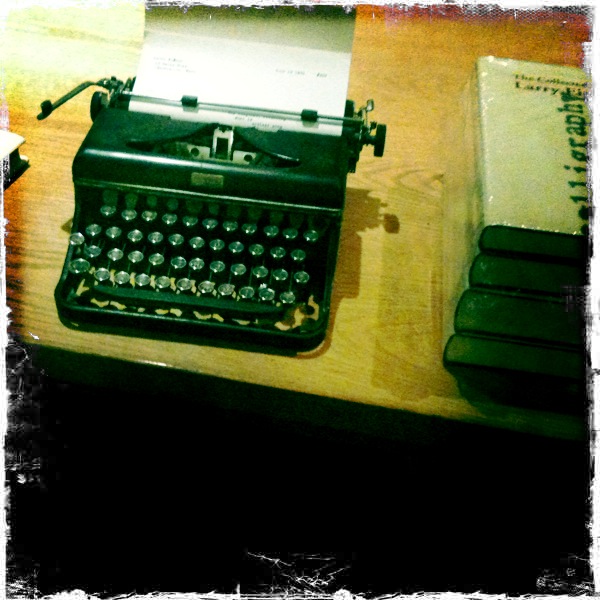
Recently, as a result of Pi O urging me to check out the poetry of Larry Eigner (by the way, this video of Larry reading poetry is great), I came upon a fantastically provocative and sensitive essay by Michael Davidson – “Missing Larry: the Poetics of Disability in Larry Eigner”.  Davidson explores why it may be that Eigner’s cerebral palsy is so rarely mentioned in critical discussions of his work – why that “blind spot”.   But he also reminds us that this omission isn’t just a biographical issue, but a poetic issue.  Eigner’s use of space on the page, his compression and brevity, his use of indentation and double-columns, the meticulous intensity of his poems – this is the way he chose to write, but it is also inevitably influenced by his physical condition.  He only had effective control over his right index finger, his body leaning on the (manual) typewriter, eyes close to the page, each word painstakingly pushed onto the page, each tap of the space-bar an effort.

What we write is shaped by our embodiment.  Not determined, but certainly shaped.  And this isn’t just about those bodies that are more visibly and obviously “disabled”.  Think about this –

What would it mean to think of Charles Olson’s “breath” line as coming from someone with chronic emphysema exacerbated by heavy smoking? Robert Creeley’s lines in “The Immoral Proposition,” “to look at it is more / than it was,” mean something very particular when we know that their author has only one eye (125). To what extent are Elizabeth Bishop’s numerous references to suffocation and claustrophobia in her poems an outgrowth of a life with severe asthma? Was William Carlos Williams’s development of the triadic stepped foot in his later career a dimension of his prosody or a typographical response to speech disorders resulting from a series of strokes?

Michael Davidson

These are big questions.  I’m just starting to think them through…  You, in your body, may be way ahead of me…

literature’s deformities (part 3 of 3)

[Below is the final, 3rd part of an essay I wrote a while back, but revised recently.  I’m currently looking at the position and impact of the unusual body in contemporary poetry – this essay looks at the role of these bodies in fiction.]

Even within the Magic Realist novel, perhaps especially within it, we find the extraordinary body laden with meaning. As a counter to the typical Western association of illness, curse, error or problem, there is the unusual body as a site or catalyst for transformation. In Erri De Luca’s God’s Mountain, a coming-of-age story set in post-War Italy, a young boy befriends a Jewish refugee from the Holocaust. Rafaniello has a hump on his back which will reveal wings to carry him to Israel.

Rafaniello is so light you can pick him up. His bones must be hollow. There’s air in his jacket. I see the curve of his folded wings and pass my hand over him to cover them better. In Naples people call the hump a scartiello. They think that stroking it brings you good luck. People are always putting their hands on Rafaniello’s hump without asking permission. He lets them. “In my hometown they called me gorbun and no one would even brush against me. Here I like the familiarity that people have with my hump. I don’t think I’ve brought anyone good luck, but all those strokes have helped me. They’ve awakened my wings”.

A body that, in its particular time and place, appears strikingly unusual will have meanings attached to it. Arguably, this could be some kind of recurrent tendency of ours to attempt to resolve intense anxiety over the results of capricious nature or of human evil.

Gunter Grass’ central character in The Tin Drum is both a magnet for such significances and ultimately manages to elude them. On receiving a tin drum for his birthday, young German boy Oskar decides not to grow up, retaining the stature of a child throughout World War Two. The drum remains his cherished possession and means of communication, along with his piercing wordless shriek which can break glass at a distance. After the war, while burying the body of his presumed father, he suddenly decides to grow again; the growth is so quick that he is deformed. Later, he earns an income and fame as an artist’s model.

Professor Kuchen led me to a studio, lifted me up with his own hands on a revolving platform, and spun it about, not in order to make me dizzy, but to display Oskar’s proportions from all sides. Sixteen easels gathered around. The coal-breathing professor gave his disciples a short briefing: what he wanted was expression, always expression, pitch-black, desperate expression. I, Oskar, he maintained, was the shattered image of man, an accusation, a challenge, timeless yet expressing the madness of our century. In conclusion he thundered over the easels: “I don’t want you to sketch this cripple, this freak of nature, I want you to slaughter him, crucify him, to nail him to your paper with charcoal!”… These sons and daughters of the Muses, I said to myself, have recognised the Rasputin in you; but will they ever discover the Goethe who lies dormant in your soul, will they ever call him to life and put him on paper, not with expressive charcoal but with a sensitive and restrained pencil point? Neither the sixteen students, gifted as they may have been, nor Professor Kuchen, with his supposedly unique charcoal stroke, succeeded in turning out an acceptable portrait of Oskar. Still, I made good money and was treated with respect for six hours a day.

For readers, The Tin Drum is almost infinitely interpretable. Oskar’s child-size body is a rejection of the duplicity and cruelty of the adult world, and his sudden deformity is his body’s own reaction to taking on that world again. His body may be the physical expression of the inability of language to express the atrocity of the War. He could be symbolic of Germany’s guilt, or perhaps of Germany’s economy. Oskar’s body has by some been conceived as a Freudian reflex. Even as the Twentieth Century itself.

Perhaps it is all of these interpretations, or even none of them. Oskar tells the story from the bed of an insane asylum, flips between the first and third person, muddies the narrative waters in innumerable ways. Grass evokes a strange kind of alienated sympathy for Oskar in his readers, but he does not want us to have confidence in Oskar’s story, and certainly not in any larger historical or national Narrative. Like the drum and the shriek themselves, what The Tin Drum speaks is both devastatingly critical and irreducible to a particular ideology. Grass offers us the truth of the inconclusiveness of reality, its essential ambiguity. The extraordinary body is certainly still a spectacle, but it also has its own uncontainable meanings.

Exceptions unsettle. They mock our sense of certainty, our familiar and comforting associations. They provoke a rupture in the mundane. Deformity can be arresting, fascinating, confusing, awe-inspiring, even spiritual. All the same, with Medicine’s accelerating ability to alleviate or remove deformity altogether, the unusual body has become even more invisible, especially in the West. This adds another layer to the archetypal response – the sense that a body has slipped through the medical net, the unnerving possibility that Nature is still uncontrollable.

The body I inhabit, or perhaps I should say, the body that I am, is visually extraordinary, due to a condition known as Marfan Syndrome. I am six foot three, and weigh around sixty-five kilograms; I am slender, with long limbs. My spine curves dramatically from side-to-side and front-to-back; I would be perhaps six foot six if my spine were straight. In a way, my body has easily adjusted to this shape. But in another way, this is the shape of my body, and it is normal. I do not experience pain or physical difficulty, as some people have assumed. My body experiences its shape in much the same way as any body experiences its shape. Except, at times it seems little literary micro-ghosts hover over my shoulder.

I was born one hundred and forty years after Quasimodo, into an immensely different era, in terms of medicine, media and social structures. Yet I have been called by his name many times, mostly from the windows of passing cars, by men in their twenties. They are gone before I can conjure an appropriate retort; ensuring I remain, for them, a body. They are not interested in the speculations of a French paediatrician Antoine Marfan, whose intense and close observations of his patients in the late nineteenth century led him to describe the key visual features of the syndrome.

Interestingly, the most common parental response to the curiosity their children display, is an embarrassed injunction not to look. I suspect this looking-away, this leaving-be, is common in many cultures, but is acutely expressed in Australia. There is a profound caution about the way we relate to each other, which reflects our political history.

In celebrating the fair go, Australians portray themselves as fundamentally relaxed about the doings of others, as tolerant. The very need to paint such a picture, however, reflects less its veracity than a wish for projecting an image. The image is defensive. “We are patient in the judgement of others” means, really, “Do not judge us”… Such an ethic is self-protective and concealing, amounting to an agreement not to discuss one another’s sins. Extending the right to a fair go amounts to an injunction to each mind their own business.

Daniel Ross, “Violent Democracy”,  2004

Everyday public speech is the very opposite of deconstruction. It leaves things, efficiently, alone. This is not just about people’s right not to be questioned about their behaviour or inheritance, but also about their bodies and the meanings attached to them. Our culture has evolved a plethora of ways of describing the other. Yet we do not seem to have grasped a way of apprehending the world, a way of speaking together, that is able to adequately deal with variety – that is able to recognise the other within the self.

literature’s deformities (part 2 of 3)

[Below is part 2 of an essay I wrote a while back, but revised recently.  I’m currently looking at the position and impact of the unusual body in contemporary poetry – this essay looks at the role of these bodies in fiction.]

Shakespeare was Freud before Freudianism, a psychologist of powerful poetic suggestion before it settled historically into a definitive diagnostic shape. In Richard III, Richard, jealous and ambitious, intensely sensitive to his deformity, plots through flattery and murder to take the throne of England.

But I, that am not shaped for sportive tricks,

Nor made to court an amorous looking-glass;

I, that am rudely stamped, and want love’s majesty

To strut before a wanton ambling nymph;

I, that am curtailed of this fair proportion,

Cheated of feature by dissembling Nature;

Deformed, unfinished, sent before my time

Into this breathing world, scarce half made up,

And that so lamely and unfashionable

That dogs bark at me as I halt by them;

Why, I, in this weak piping time of peace,

Have no delight to pass away the time,

Unless to spy my shadow in the sun

And descant on my own deformity:

And therefore, since I cannot prove a lover,

To entertain these fair well-spoken days,

I am determined to prove a villain

And hate the idle pleasures of these days.

The snowball-like trajectory of tragedy ensures we cannot (like Richard himself) see any other possibility. The exact fuel for Richard’s machinations is left unclear. The ugliness of his body could be a catalyst for his political and moral degeneracy, or a convenient excuse for it. At the very least, the play portrays physical deformity as psychological intensification. Richard is shut out from what he sees as his entitlement, grows increasingly resentful and determines to assert himself, to challenge the place assigned to him by nature.

Regardless of the measure of propaganda that influenced the transition of the historical story to the theatrical script, there is a familiar association hunching over Shakespeare’s version of Richard – the shadow of gendered power. Julio C Avalos Jr reminds us that the common conception of women at the time was that they were half-made men. Richard sees himself not just as unattractive in appearance, but as insufficiently male.  Violence and usurpation present themselves to him as the sufficient proof of manhood. Tragic indeed.


literature’s deformities (part 1 of 3)

[Below is an essay I wrote a while back, but revised recently.  I’m currently looking at the position and impact of the unusual body in contemporary poetry – this essay looks at the role of these bodies in fiction.]

It is almost a truism to say that each body is unique – medically, biologically, psychologically. Not only that, but each body is unique in each moment, continually in a state of flux and vulnerable to threat – healthy one moment, deformed or worse in the next. And yet, for almost all characters in literature, the particularities of their bodies are insignificant. Their embodiment is either unmentioned, or most often secondary to the narrative, or subsumed within the common human body, a device for identification.

Deformity, on the other hand, always seems symbolic in some way. If the body of a character is unusual, it determines that character’s entire identity, trajectory and destiny. It is as if, for the author and the reader, deformity is a provocation towards fate. I am interested in how these portraits of extraordinary bodies shape (or, it could be said, mis-shape) how we see other people, even how we see ourselves. This essay hopes to direct an unflinching gaze upon that looking.


Did Victor Hugo fully know what his vision would contain? Hugo would say yes, but what would Quasimodo have said? He could, of course, only speak Hugo’s words, could only make the movements prescribed for him. And Hugo’s Quasimodo isn’t exactly articulate. He is brutish, a lump of flesh, as if an excess of physicality must inevitably swamp the intellect.

If the epic story The Hunchback of Notre Dame could be reduced to a few sentences, it would be because of its melodrama. Quasimodo, born severely deformed, is abandoned at the steps of Notre Dame and taken in by the archdeacon Frollo, who is infatuated with the beautiful young gypsy woman Esmerelda and has her beau Phoebus stabbed. Esmerelda is charged with attempted murder. Quasimodo abducts her and takes her back to the cathedral, which is then assailed by the mob. Esmerelda dies in the commotion. Quasimodo realises Frollo, his proto-adopted-father, was behind the whole scenario, and kills him. In deep grief, he then entombs himself with the body of Esmerelda – a tragic resolution, certainly, but also oddly fitting for a central character who, essentially, is imprisoned in his embodiment, whose body offers only questions, especially to those who cannot identify with him.

Consider Hugo’s sketch, and the struggle to explain Quasimodo.

His whole person was a grimace. His large head, bristling with red hair – between his shoulders an enormous hump, to which he had a corresponding projection in front – a framework of thighs and legs, so strangely gone astray that they touched only at the knees, and when viewed in front, looked like two sickles joined together by the handles – sprawling feet – monstrous hands – and yet, with all that deformity, a certain awe-inspiring vigour, agility and courage – strange exception to the everlasting rule which prescribes that strength, like beauty, shall result from harmony… One would have said a giant had been broken and awkwardly mended.

The portrait, in its avalanche of hyperbole and its convoluted grammar, is as deformed as the character. Hugo’s Quasimodo literally embodies a mistake, and the tragedy that results. He is an engine room for the building up of archetypal associations. He is immensely strong and correspondingly simple in his intellect. He is unpredictable, a reflection of the capricious nature which created him. The crowd certainly don’t understand him. He is deaf; the world does not quite reach him. What moves him is the female of the story; yet she is unattainable. Esmerelda continually struggles to see the human in him, trying to imagine how this giant’s puzzle pieces could be more humanly rearranged, while knowing they never will be. He is intensely alone. In his gentle monstrousness, he is able to be manipulated; his surrogate father Frollo leads him astray. He is not the mob, nor is he the reader. He approaches but never quite reaches the full status of a subject.

Quasimodo is both practically celibate and literally promiscuous – the voice of Hugo reverberates through many bodies, gives birth to many children. Visualise the many assistants to mad scientists – hunched over, shuffling obediently to their masters’ next tasks, muttering a vague sense of resentment, yet perennially faithful. Think even of the titular anti-heroes of low culture teen flick Revenge of the Nerds – genetically made other, socially disadvantaged (in a reversal of Quasimodo’s physical/mental imbalance); the clumsy, inarticulate virgins who the audience secretly place in sexual positions, wondering how those bodies would “do it”.

But the strongest family resemblance to Hugo’s child can be seen in the freak show, that institution that Rosemary Garland Thomson called “the apotheosis of museums” that arose in the mid nineteenth century and continued well into the twentieth (and arguably survives in other forms now). “Siamese” twins, little people, giants, tattooed people, half men-half women, sword swallowers, those with extra or no limbs, fat people, African “primitives”, and many others selected according to the anxieties and fascinations of the era performed theatrically, thereby providing both immense entertainment and reassurance of the security of the audience’s physical, racial, sexual and cultural status. The stage is the boundary. The audience become the norm(al) purely and simply by being outside of the spotlight.

Quasimodo defines both the isolated deformed body and the form of the mob.

[part 2 & 3 will appear in later posts…]

Staring: How We Look

An eye-snagging stare of intense attention opens a social relationship between two people.  The kind of visual scrutiny leveled by a stare is both impersonal and intimate…  Staring affords a spontaneous moment of interpersonal connection, however brief, during which two people have the opportunity to regard and be known to one another.  So while social rules script staring, individual improvisation can take the staring encounter in fruitful directions.

– Rosemarie Garland Thomson, “Staring: How We Look”

It may appear almost common-sense in its analysis, but this book went against my grain.  Thomson is a engaging, erudite and humane writer, and she has written a non-fiction page-turner, but often I found it hard to read.  Why?  Was it because I disagreed with her?  No.  It was because I didn’t want to.  Staring: How We Look forced me to admit I had lived a lot  of my life focussing on only half of the dynamics of staring.

Staring: How We Look

Thomson’s premise is this – there are two sides to staring – not only the starer and staree, but the two competing impulses – the irresistable physical impulse that drags our attention onto an unfamiliar sight, and the cultural injunction, with all its immense strength, to grant each other “civil inattention”.  When staring happens, starer and staree make meaning together.

Of course, there are different kinds of stares – blank stares, staring as dominance behaviour, the intense “baroque staring” prompted by scenes of death or decay, affectionate curious staring, confused bewilderment staring, sexual predatory staring, and many more.  It’s complex terrain, but Thomson navigates it with intelligence and compassion – she never flinches from our conflicting, very human instincts for violence and for intimacy, for “othering” and for love.

She also emphasises that that meaning-making is never determined in advance but depends on the goodwill of the starer and the staree, the process they engage in, their ability to shift the interaction from staring at an extraordinary aspect of someone’s appearance towards an attention that recognises that person’s broader self.  Not that their difference disappears (that happens when people look away); in fact, it finds its proper place.

Staring: How We Look reminds me that the circumstance of staring holds great ethical responsibilities and opportunities.  Deep inside me, I do not want it to be inevitable – to find myself as staree or starer can be uncomfortable, even upsetting – but that’s precisely the point.  Our sense of what and who is normal or beautiful, or what lives fit into the recognisably human, can too easily become rigid and narrow.  We need surprises.  We need unusual sights to jolt us out of ourselves.


"Shayla" by Doug Auld, oil on canvas

Thomson uses the term “visual activists” to describe those people who have stareable bodies who make it their business not only to be seen, but to take charge of that encounter.  They are the people who broaden our humanity, who move us towards the hard work of attentiveness, of mutual recognition.

It’s hard work.  I’m rarely in the mood for it.  But it can be worth it.


Bodies of Poetry (an introduction)

Poetry is an artform of language, with its roots firmly within the body – in its fascination with embodied experience and in its incorporation of bodily rhythms.  But whose body are we talking about?  Apart from the question of male and female bodies, how are bodies that are deformed or unusual treated?  Does poetry reinforce a clear line between “human” and “abject”?  Or can it complicate our perception of normality?

This was to be the starting-point for my Masters thesis this year.  As it turns out, I was accepted into the program but missed out on a scholarship.  Since I don’t have a year’s income saved up, I’ve decided I’ll pursue this topic of mine outside of the University.  Masters without a Masters.  Who knows how long it will take, or if I’ll drop it half-way.  But the reading and thinking will be worth it.

My interest in poetry and physical difference is intrinsically linked with my personal experience. I was born with Marfan Syndrome, which has resulted in severe spinal curvature, yet without any significant physical impairment. My own poetry seeks to express the subjective experience of being visibly different, and is in some way an attempt to reverse the usual dynamic of naming and identification.

And, since I don’t want to be doing this “non-Masters” alone, I’ve decided to post short mini-essays on this blog, in a series entitled “Bodies of Poetry”.  I’m interested in how non-standard bodies find expression in poetry.  Poetic licence of the body.  I’d love your feedback, ideas, suggestions, personal stories, rants, whatever you feel fits into the topic, from whatever angle.

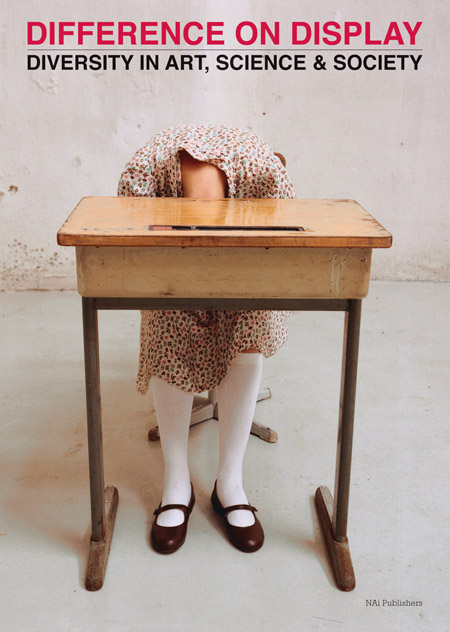
My partner and I just recently found a great little shop, upstairs at 381 Sydney Road – Mr Kitly – which has some great books on design, art, architecture, and some gorgeous tea cups and crockery.  Yes, very “new Brunswick”.  Anyway, we found this book – “Difference on Display: Diversity in Art, Science and Society”.

"Difference on Display: diversity in art, science and society"

It’s a mix of artists, film-makers, performers, theorists and activists – Donna Harraway, Tom Shakespeare, Bruce Nauman, William Kentridge, Patricia Piccinini, Louise Bourgeois, Critical Art Ensemble, and a lot more – and it approaches diversity and normality from a huge range of angles.  I’m sure it will find it’s way into my thoughts as they emerge here…

Again, yes, any suggestions and thoughts are very welcome, particularly on poets I should read…